
Let’s ideate over coffee.
Every generation of programmers believed they were writing software the hard way, the real way. Every generation was eventually proved half right.
01 · The pastEvolution of machine interaction
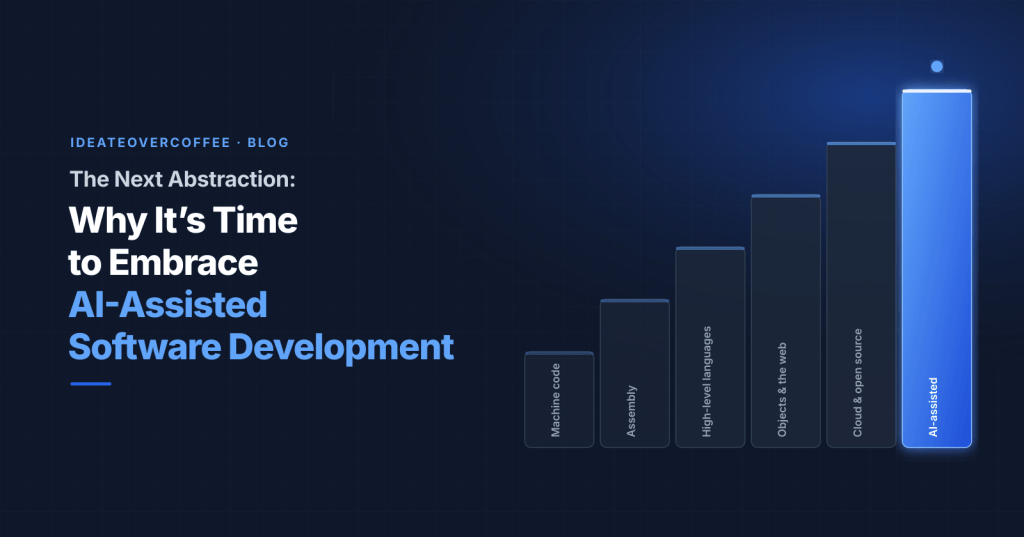
In the early days of computing, programmers fed machines instructions practically one bit at a time: switches, then punched cards and paper tape. A single misplaced hole could cost a day’s work. Assembly language offered a little relief, replacing raw numbers with short mnemonics, but machines dictated the terms and lexicon.
Then came the first real leap. FORTRAN arrived in 1957 and COBOL in 1959, attempting to use human vocabulary and mathematics. Skeptics worried that this compiled code would be slow and that programmers would lose touch with the hardware. Both worries had some truth in them. Neither stopped the change.
The pattern repeated with each new wave. C in the 1970s, object-oriented languages like C++ in the 1980s and then Java in 1996. Then came the web, open-source libraries, cloud platforms and agile teams. Each step let developers stop worrying about one layer of detail so they could focus on a higher one.
02 · The patternThe pattern behind every shift
Look closely and every one of these shifts followed the same arc:
A new layer of abstraction hid tedious detail.
Experienced practitioners worried about lost control, quality or skill.
Early adopters proved the gains were real.
The new layer became the normal way to work, raising the bar for what one person could build.
Few developers today write assembly by hand, and almost nobody misses punched cards. The skills did not vanish. They moved up a level.
03 · TodayThe newest layer
AI-assisted development is the latest step on that staircase, and the fastest. Tools that once suggested the next line of code now draft whole features, explain unfamiliar codebases, write tests and fix their own errors. By early 2025 the practice had a name, vibe coding: describing what you want in plain language and shaping the result with an AI partner.
The effect is already visible. Experienced engineers ship in days what used to take weeks. Small teams build products that once needed whole departments. Some individuals now run software businesses largely on their own, playing product manager, developer, tester and user, simultaneously.
04 · Why nowWhy now is the time to embrace it
Every earlier transition rewarded early adopters of the new layer, allowing them to use the layer beneath more efficiently. This one is no different, for three reasons.
05 · The caveatWhat doesn’t change
None of this makes engineering judgment obsolete. If anything, it makes it more visible. AI tools still make confident mistakes. They can miss the root cause of a bug, pick a poor design, or produce an interface that works but feels wrong to a real person. Someone has to notice.
The work shifts from typing code to directing it: defining the problem clearly, reviewing what comes back, testing it the way real users will, and owning the result. These are the skills of product managers, architects and quality engineers as much as of programmers. The developers who thrive will be the ones who combine them.
Security, privacy and maintainability still matter, and so does knowing when not to trust the output. Embracing AI-assisted development does not mean handing over responsibility. It means taking on a new kind of ownership.
The better question is not whether to adopt AI-assisted development, but how to use it well.
06 · The choiceThe next rung
Seventy years ago, writing a program meant the non-intuitive process of punching holes in cards. Today it can start with a conversation. The distance between an idea and working software has never been shorter.
History suggests that resisting a new level of abstraction rarely works for long. The better question is not whether to adopt AI-assisted development, but how to use it well. Those who start now, with curiosity and with care, will be the ones who shape what software development becomes next.
07 · Looking aheadWhere is this heading?
No one can say for certain where software development goes next. But one possibility is worth thinking about.
AI assistants are already being built into the operating systems on our phones, and they are learning to take actions inside apps on a user’s behalf. Follow that path far enough and it leads somewhere interesting.
Perhaps one day, there will be no such thing as an app. People will simply tell their device what they need, and the operating system will assemble the right functionality on the spot — built for them, in the moment, and gone when they are done.
Further out still, software as we know it may no longer be written at all. In place of millions of separate programs, there could be one universal piece of software that reshapes itself into whatever is needed, at the whim of a prompt.
If that happens, the journey from punched cards to AI-assisted development will turn out to have been just the beginning.
Ideas, apps and more over coffee
Find my apps and more at IdeateOverCoffee.com.
Disclaimer: Drafted alongside my AI writing partner to sharpen and articulate my thoughts.

