
Let’s ideate over coffee.
Today’s AI has read basically everything.
It can write, code, pass exams, and hold a conversation on almost any topic. But it has never smelled coffee, felt warmth, or tasted salt. It knows the word for everything, but the feel of nothing. This gap is a major bottleneck on the path to AGI — not just a lack of data or model size. Language is a description of the world, not the world itself.
Score today’s AI on the five senses and it’s lopsided:
- Vision and hearing are advanced because cameras and mics made that data cheap and abundant.
- Touch, smell, and taste lag behind because they are grounded in chemistry and physics — messy, analog, and hard to digitize.
Yet those missing senses are deeply tied to survival, emotion, and physical reality.
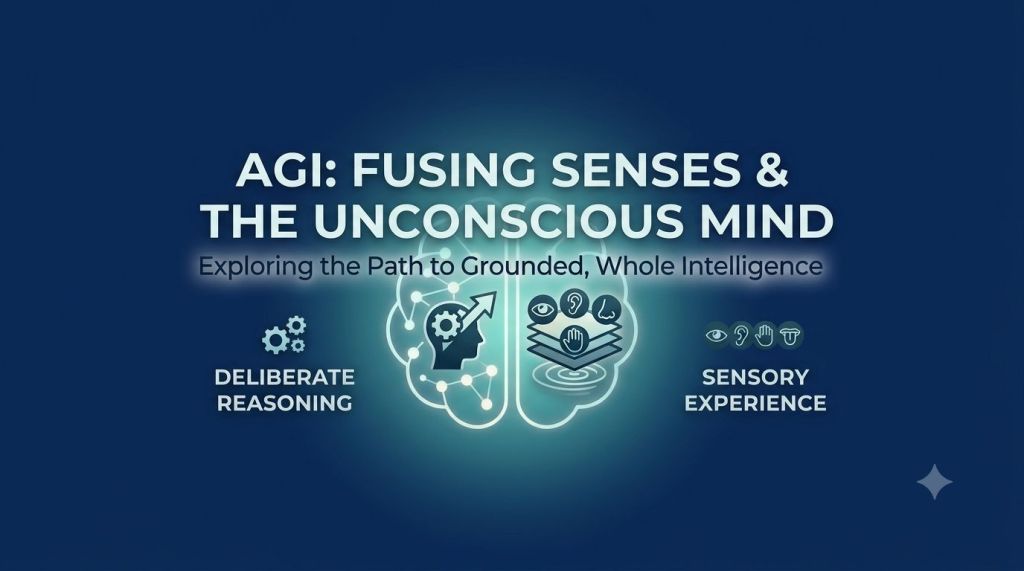
Real progress happens when all five senses feed into one model and fuse into a single stream of experience — the way your brain merges the sizzle, smell, and taste of food into “dinner.” That fusion builds true understanding. A child doesn’t learn glass is fragile just by reading about it — they see it shatter, hear it crash, and feel the sharp edge. That is a grounded world model.
There is also a second layer: the subconscious stream.
Your senses feed your brain a staggering amount of raw data every second, while conscious awareness catches only a fraction. Much of human intelligence operates beneath the surface — processing multi-sensory inputs in real time to form gut feelings and spatial intuition.
Current LLMs operate purely on text-based pattern recognition. They can imitate a gut feeling by predicting what one sounds like, but they lack the underlying sensory perception that creates it.
The idea I’m tracking: pair a grounded, multi-sensory foundation with a deliberate reasoning layer — sensory grounding and high-level cognition working together. Not just AI that is more powerful, but AI that is more whole.
Researchers are already exploring sensory AI, robotics, and world models, but connecting these dots — sensory fusion + subconscious processing — feels like the necessary path forward toward AGI.
Curious what others building in this space think. If you’ve come across papers, projects, or architectures touching on sensory AI, world models, or embodied intelligence, drop them below.
Disclaimer: Drafted with the help of my AI writing partner, who helps me organize and articulate my thoughts. Can’t imagine a world without ANI, let alone AGI.

